


A small vessel drifted to a stop in the Eastern Pacific, its hull punched open from above, two people dead in the water, and one man somehow alive. The missile that found them came from a distant campaign that almost no one on shore can explain in full.
TLDR
On February 9th, 2026, a U.S. strike destroyed a suspected narco-trafficking vessel in the Eastern Pacific, killing two and leaving one survivor in a little-known maritime campaign.
The strike formed part of an expanding series of lethal operations against boats tagged as narco-terrorist platforms moving between Central America, South America, and the Caribbean. The targeted vessel traveled along a known smuggling corridor in the Eastern Pacific, fell under the category of a designated terrorist organization, and was classified as engaged in narco-trafficking operations.
Pattern of Lethal Strikes
The February strike did not come out of nowhere. Since a new maritime campaign began in September, aircraft and ships under the United States Southern Command, the regional combatant command known as SOUTHCOM, have tracked and hit small vessels that intelligence links to drug-financed armed groups.
Monday’s operation counted as the third known strike of the year. Days earlier, another boat in the region took a similar hit, leaving two suspected traffickers dead. In January, yet another vessel ended the same way, with two killed and a single survivor pulled from the water.
Public descriptions present these attacks as tightly controlled actions against vessels operated by designated terrorist organizations, including networks connected to Venezuela’s Tren de Aragua and Colombia’s ELN. The language surrounding the missions leans on technical terms like lethal kinetic strike, words that point to precision and legality while avoiding the uglier shorthand of execution.
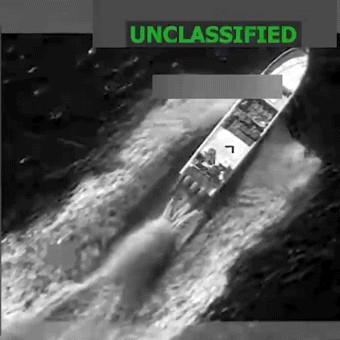
Video clips show the February 9th target as a small craft running low in open water, then a flash from above, then a sudden halt. The hull rocks, loses momentum, and drifts. From the vantage point of an airborne sensor, the sea looks flat and empty, with no visible faces and no audible voices.
🇺🇸 🇻🇪 ⚡️ — NEW: US Southern Command says a “lethal kinetic strike” on a vessel in the eastern Pacific killed two people and left one survivor.
🔴 US SOUTHCOM said the strike targeted a vessel it alleged was involved in drug trafficking and that two “narco-terrorists” were… pic.twitter.com/udKavOHGci
— The Palestinian Observer (@TPObserver) February 10, 2026
A Survivor Alone in Open Water
After the weapon hit, search and rescue protocols went into motion. The combat platform did not linger to scoop bodies from the water. That job fell to other assets, including the United States Coast Guard, which activated its systems to locate anyone still alive in the debris field.
Somewhere out on that patch of Pacific, one person survived. The pattern matches the earlier January strike, which also left a lone survivor. In each case, a small crew set out along a route known for narco-trafficking, came under sudden fire from above, and ended with one person plucked from the sea and taken into custody.
The public record does not tell that survivor’s story. There is no name, no age, no nationality, no photograph. There is no public docket listing charges, no visible indictment in a federal database, and no explanation of whether that survivor now sits in a detention center, a hospital ward, or an interrogation room.
Without a name, the survivor becomes something else, an anonymous data point that justifies the operation itself. The fact that one person lived reinforces the message that the strike was precise enough to avoid total annihilation, even as the dead vanish into the category of suspected narco-terrorists.
Legal Gray Zone at Sea
On paper, these missions sit at the intersection of counterterrorism, counter-narcotics, and maritime security. The targets move drugs along routes that bankroll armed groups classified as terrorist organizations. The vessels often sail without clear national markings, inviting arguments that they float outside the protection of any flag state.
Those legal theories carry serious weight. They can turn a fiberglass hull full of fuel drums into a lawful military target, even in peacetime and far from any traditional battlefield. They can also erase the line between law enforcement and armed conflict, shifting decisions about life and death from courtrooms to cockpit displays.
Domestic law gives the U.S. military authority to support drug interdiction and to disrupt organizations on terrorism lists. International law permits action against stateless vessels and some forms of self-defense at sea. Nowhere in that dense web of statutes and treaties, however, is there a public checklist that explains exactly when an American crew can launch a missile at a boat of suspected smugglers.
In a courtroom, prosecutors’ claims must survive cross-examination. Evidence must be tested, witnesses must answer questions, and a judge must rule. In the Eastern Pacific, the burden of proof is folded into classified intelligence streams and rapid targeting decisions, then sealed behind layers of operational secrecy.
Targets Without Names
The February 9th strike killed two people, yet their identities remain absent from any official narrative. No agency has publicly listed their names, origins, or prior records. Their families, wherever they live, may never receive formal notification explaining how or why their relatives died in distant waters.
This is the quiet reality of a campaign built around intelligence-driven targeting. The vessels are described in detail, down to their speed, profile, and likely cargo. The networks are mapped, their acronyms repeated in press releases. The individuals on board are reduced to roles: gunmen or couriers, mechanics, and sometimes simply bodies in the wake.
The pattern of two dead and one alive recurs across multiple strikes. If a court issued death sentences at that rate, it would provoke outrage and appeals. At sea, the ratio exists only as part of a scoreboard of tonnage seized, routes disrupted, and organizations degraded.
Without independent observers on scene, the outside world has no way to verify who exactly dies in these operations. A fishing crew pressed into service by traffickers, a coerced mechanic, or a teenager paid to stand watch on deck would look identical on an infrared screen to a hardened enforcer.
Quiet Campaign, Growing Questions
SOUTHCOM’s area of responsibility stretches from the Caribbean to the Southern Cone, an expanse of water and coastline where drugs, migrants, and money flow past fragile states and corrupt officials. For years, most interdictions in that arena involved helicopters, cutters, and boarding teams rather than precision weapons.
The recent shift toward lethal kinetic strikes marks a harder edge. It spares American crews the risks of close-quarters searches in rough seas. It also concentrates power in the hands of distant command centers that approve kill shots based on sensor feeds and intelligence summaries.
Public messaging about the February 9th mission emphasizes operational success and the role of the survivor as a source of intelligence. It does not address how mistakes would be detected, who reviews civilian casualty allegations, or whether any independent body has access to the raw footage and targeting data.
As the campaign continues, each new plume of water and fire in the Eastern Pacific raises the same unresolved questions. How certain is the intelligence behind each strike? What happens to the survivors pulled from the sea, and who, if anyone, speaks for the dead whose names never appear in any report?
References