


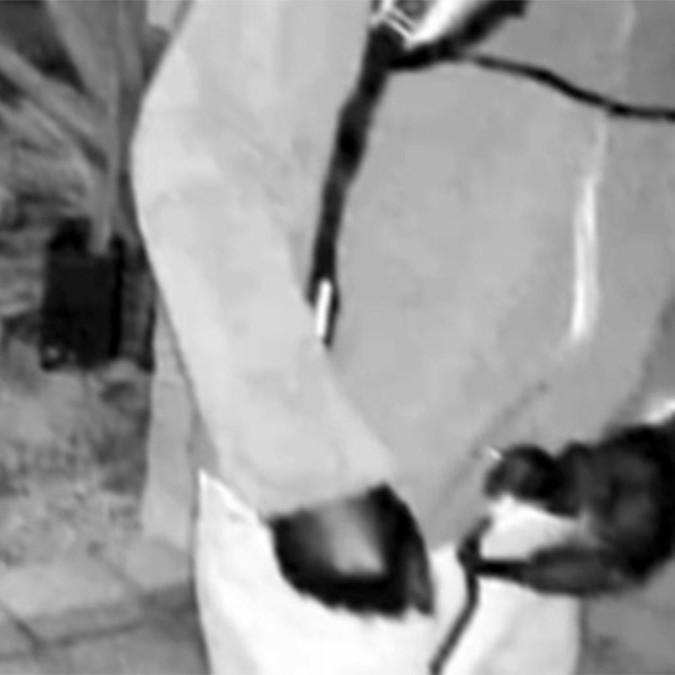
If the person who killed Nancy Guthrie understood guns, why does the holster in the surveillance video look like it belongs to someone who does not?
TLDR
Surveillance video in the Nancy Guthrie killing spotlights a mismatched holster, raising doubts about the gunman’s training and the investigation.
On January 31st, 2026, 42-year-old Tucson resident Nancy Guthrie was shot in a parking lot on the city’s east side. Publicly released surveillance footage captured a blurred figure moving past bright sodium lights, a handgun at the hip. The video answered almost nothing about motive or identity, and it opened a new dispute over one stubborn detail that keeps resurfacing in frame after grainy frame.
The Frame-by-Frame Problem
The video is not generous. The suspect never looks fully toward the camera. The face is hidden under the brim of a cap, the walk is hurried, and the shadows do most of the work.
Yet near the suspect’s waist, one thing is sharp enough to study. A dark, soft-sided holster rides high on the belt line. Jammed into it appears to be a semi-automatic pistol with a squared slide and a flat-sided trigger guard.
Freeze the footage at the right second, and the mismatch jumps out. The holster flares and bulges in places where it seems to expect a revolver’s rounded cylinder, not the straight, rectangular profile of a semi-automatic. The mouth of the holster gapes, the fabric looks loose, and the pistol seems to sit shallow, as if one hard jolt could send it tumbling.
Seasoned gun handlers who reviewed the footage zeroed in on that pairing. One former FBI agent who examined still frames called the setup “incredibly amateur and unsafe,” arguing that no one with basic handgun training would trust a semi-automatic to a soft polyester scabbard that does not appear to match it.
Former FBI agents criticize holster configuration in Nancy Guthrie case surveillance video, calling it “incredibly amateur and unsafe.” Source: https://t.co/ELY93AUbFy · Feb 13, 2026 00:31 UTC pic.twitter.com/JuMTCRIWRZ
— TapForNerd (@tapfornerd) February 13, 2026
That judgment turns a utilitarian object into a live question. Is the holster a careless mistake, or a deliberate piece of misdirection?
An Amateur Mistake or a Careful Performance
The tension in the Guthrie case sits at the hip of the unknown gunman. The holster looks cheap, the fit looks wrong, and the placement appears odd, riding forward of the hip in a position that would make a fast draw clumsy.
Gun professionals describe a basic rule: the holster should secure the weapon, protect the trigger, and keep the gun in a repeatable position every time the carrier reaches for it. In the Guthrie video, the holster appears to do none of those things especially well. The fabric collapses around the pistol, the top is open, and there is no visible locking system.
In one sequence, as the suspect moves quickly across the lot, the pistol grip seems to cant outward. The angle suggests the gun is resting more on friction than on design. Anyone who has ever sprinted with an ill-fitted holster knows the sickening bounce that comes with it, and the very real risk of the weapon spilling out or shifting into an unsafe position.

This is where the case splits. One reading paints the suspect as a reckless civilian, someone who picked up a bargain-bin holster and stuffed in whatever handgun they had access to, never mind compatibility or safety. Another, darker reading wonders if that is exactly what the suspect wanted viewers and investigators to believe.
An obviously wrong holster can act like a costume piece. It can suggest inexperience, poverty, or desperation. It can obscure the owner’s real pattern of gun use. If the killer typically carries a different holster, on a different part of the body, dropping into this mismatched gear turns the crime itself into cover.
Training, Access, and Who Carries What
Behind the argument over a few pixels of polyester sits a larger map of who carries what, and how. People who handle guns for a living tend to be strict about holsters. Armed professionals usually favor molded Kydex or heavy leather rigs built around specific models, often with retention features that lock the weapon until the wearer defeats a lever or notch.
Those holsters hug the firearm. The outline is crisp, the mouth stays open, and the gun clicks or presses into place in a way that the hand can feel even in the dark. A loose nylon sleeve, by contrast, accepts many shapes and secures almost none of them with precision.
That divide makes the Guthrie footage more than an aesthetic oddity. If the pistol is truly a semi-automatic, and if the holster truly matches the common revolver-style designs sold at big-box stores, the combination points away from the habits of police, armed security, or military personnel. It fits more neatly into the world of casual owners, first-time carriers, and people who pick up gear based on availability rather than doctrine.
But even that is not simple. Discount holsters can be gifts, hand-me-downs, or stolen items. The gun itself, which appears to be compact and dark, could be anything from a legally purchased carry pistol to a trafficked weapon with obliterated serial numbers. A mismatched setup can reflect ignorance, necessity, or deliberate improvisation.
For investigators working the case, the holster is less symbol and more potential database key. Retail chains track purchases. Shooting ranges keep logs, remember regulars, and sometimes remember unusual setups. A semi-automatic forced into a floppy revolver holster is the kind of detail that tends to stick in people’s minds.
Whether anyone ever reported seeing that exact pairing in the weeks before Guthrie’s death remains, at least publicly, an unanswered question.
Investigative Silence Around a Critical Detail
Since the surveillance clip went public, the holster has become the most talked-about object in the case that is not the gun itself. Yet official statements have remained conspicuously quiet about it.
The video release came without any public request for information about holster brands, retailers, or local sightings of the same setup. No flyers were singling out the gear, no press bulletins naming possible manufacturers, and no clear explanation of how central the holster is to the working theory of the crime.
That silence fuels competing interpretations. One possibility is simple caution. If the holster ties into a promising lead, broadcasting too much detail could flush a suspect, spook potential witnesses, or contaminate future identifications. Asking the wrong question in public can make the right answer useless in court.
The other possibility is more troubling. When the most obvious anomaly in a high-profile killing goes unaddressed, it invites speculation that investigators either undervalued it at first or are reluctant to admit that such a basic detail sat unexplored for too long.
Did anyone systematically pull sales records for generic polyester holsters in the Tucson area in the months before January 31st, 2026? Were big-box sporting goods aisles canvassed for employees who remembered a customer awkwardly jamming a semi-automatic into the wrong rig? Have local ranges been shown still frames of the gear, not just the suspect’s face?
Public statements so far do not answer those questions. What remains is the impression of a case whose most visible clue hangs just out of analytic focus.
A Family, a City, and an Unstable Clue
While specialists argue over stitching, retention, and draw angles, Guthrie’s family lives with what the video does not show. The camera never captures a clear shot of the killer’s face, never records the moment of the shooting itself, and never reveals a license plate. It lingers instead on a silhouette, a brief flash of metal, and a piece of fabric that may or may not be the case’s sharpest edge.
Friends describe Guthrie as someone who kept a predictable routine, finishing a late shift and stopping by the same shopping center on her drive home. That predictability deepens the unease. If the killer knew her schedule, the ambush looks planned. If not, the attack becomes a collision between a stranger with a gun and a woman who happened to park in the wrong place at the wrong time.
In both versions, the holster still matters. A person who plans a killing carefully usually plans their equipment. The choice to rely on a flimsy, ill-fitted rig around a semi-automatic pistol either reflects a blind spot in that planning or an effort to send investigators chasing the wrong profile.
In the months since the shooting, no arrest has been announced. The handgun has not surfaced in any public account. What endures is a clip of video that forces everyone who studies it to assign meaning to the details that are left.
The Guthrie case now sits at the intersection of ballistics, behavioral profiling, and basic gear selection. The unstable holster at the suspect’s hip may eventually prove to be a breadcrumb that leads to a name, or it may remain nothing more than a taunting reminder of how much violence can hide in the gaps between pixels.
Until someone steps forward, or until another act of carelessness exposes the same mismatched setup in clearer light, the most visible clue in Nancy Guthrie’s killing will stay exactly where it is in the video: loose, precarious, and one hard jolt away from falling out of the frame.
References