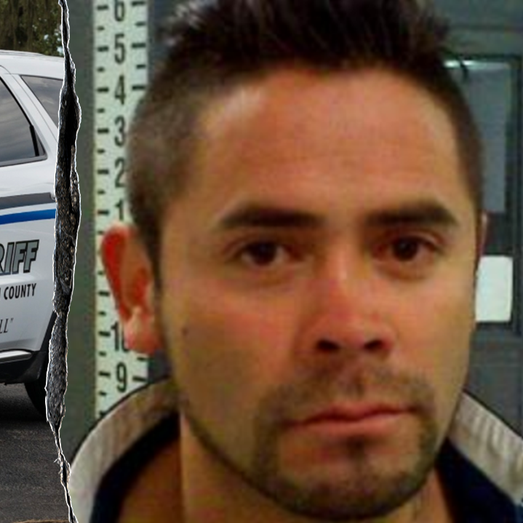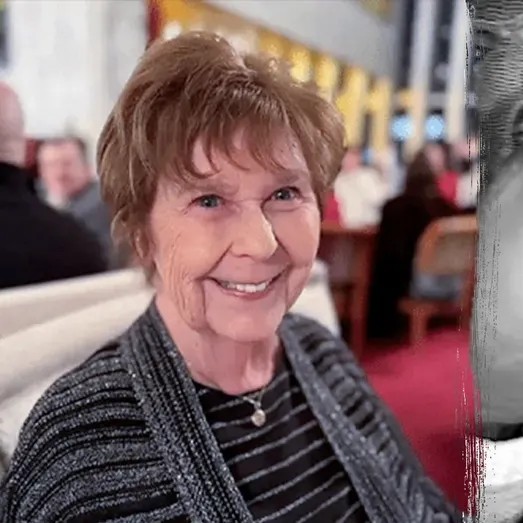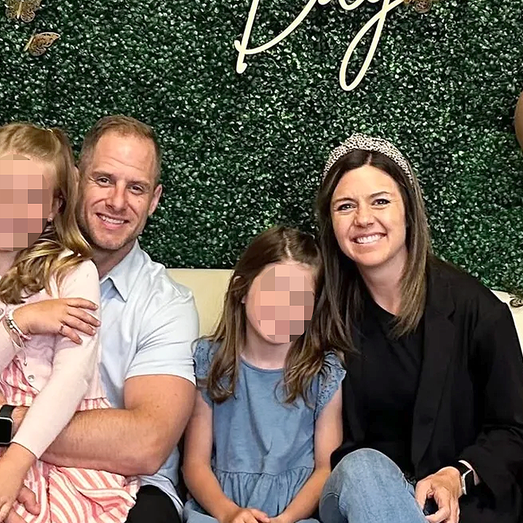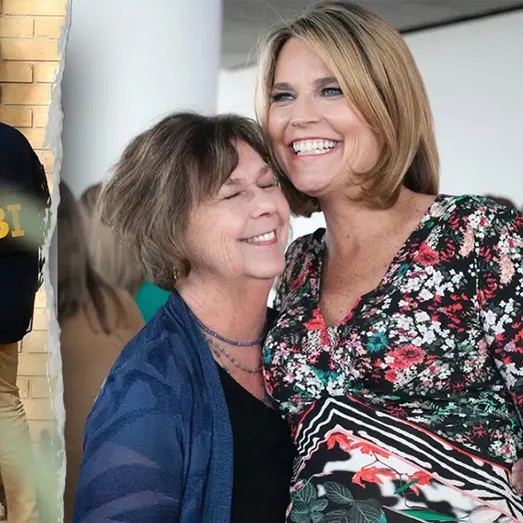


By the time the college crowd emptied out of the arena and the lights cooled on the hardwood, the search for Nancy Guthrie was still missing three crucial things: a confirmed suspect, a clear timeline, and a sheriff who did not have to explain why he had been sitting near the front row at a basketball game while a ransom plea from the victim’s children hit social media minutes later.
TLDR
Nearly a week after 84-year-old Nancy Guthrie vanished from her Tucson home, ransom notes without proof of life collide with scrutiny of Sheriff Chris Nanos over delayed air support, an early release of the crime scene, and his choice to attend a college basketball game during the still-urgent search.
The disappearance of Nancy Guthrie, the 84-year-old mother of television anchor Savannah Guthrie, began as a quiet gap in a suburban Tucson Sunday and turned into a national kidnapping case. Investigators treated the case as an apparent abduction from Guthrie’s home, a ransom demand emerged without proof that she was alive, and a $50,000 reward went on the table, yet no suspect has been publicly named as the first week closed.
A Week Without Nancy
Early on that Sunday morning, Guthrie was simply gone from the house where she lived alone in a neighborhood north of central Tucson. There was no public report of a car accident, no medical emergency logged, no neighbor who could say they watched her walk away under her own power.
What followed was the sort of sequence that families of the missing come to memorize. A welfare check. A home sealed off as a possible crime scene. A search grid on desert terrain that can turn deadly for a younger, healthier person, let alone an 84-year-old. Then, quietly, a chilling shift: a message that claimed to speak for kidnappers.
The first communication, routed to Guthrie’s family, framed the disappearance as a kidnapping for ransom. It prompted investigators to treat the case not as a confused elder wandering off, but as a targeted crime. The message did not come with proof of life, and it did not come with a body. It came with demands.
By Friday of that week, a second purported statement surfaced through local media, again pointing toward ransom and again failing to offer any verifiable sign that Guthrie was alive. The empty space between the demands and any proof of her condition set the tone for the investigation: high drama, thin facts.
Public Pleas and a Silent Kidnapper
While investigators chased leads that have not been laid out to the public, the loudest moves came from Guthrie’s children. Savannah, her sister Annie, and her brother Camron turned to the one platform they could control: a shared Instagram account watched by millions.
In their latest message, posted shortly after the final buzzer of the college game that would spark controversy about the sheriff, they addressed the people, claiming to hold their mother.
“We received your message, and we understand,” they wrote. “We beg you now to return our mother to us so that we can celebrate with her. This is the only way we will have peace. This is very valuable to us, and we will pay.”
The plea was raw, direct, and public. It did what investigators had not yet done in full view of the country: it spoke to the kidnappers as if they were real, reachable, and still listening. The account did not describe any law enforcement strategy. It simply offered money and mercy in exchange for an 84-year-old woman.
On the other side of the equation was silence. No confirmed follow-up note, no verified call, no video. Just a family broadcasting to an invisible audience and a community watching to see if anyone would answer.
The Sheriff at the Ballgame
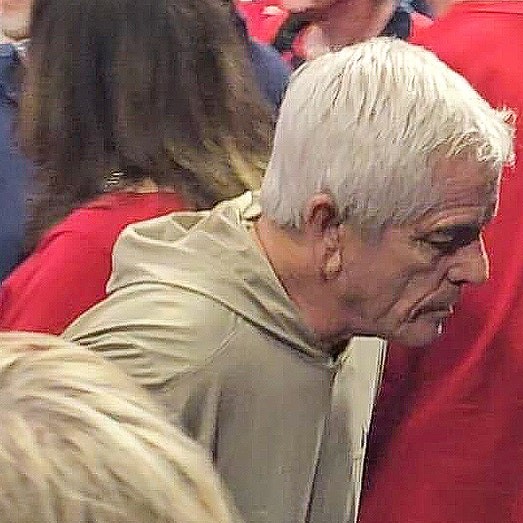
That same Saturday night, one week into the search, the sheriff who carries legal responsibility for the case took a different kind of seat. Photographs captured Pima County Sheriff Chris Nanos sitting near the floor at a University of Arizona basketball game against Oklahoma State, a marquee matchup in a town where college sports double as civic religion.
In any other week, it would have been a routine night out for a veteran official with nearly 50 years in uniform. In this week, the image landed like a contradiction. On one side of town, an arena full of fans, music, and bright lights. On the other, a family begging strangers to return an elderly woman who might already be dead.
The pictures of Nanos at the game spread quickly, reframed not as a private moment but as a public choice. Residents watching the case unfold started asking their own questions. If the sheriff had enough free time to sit at a high-profile sporting event, what did that say about the urgency and direction of the investigation, and about how seriously top leadership viewed the still-missing victim?
Pima County Sheriff Chris Nanos, who is leading the investigation into the disappearance of 84-year-old Nancy Guthrie (mother of NBC’s Savannah Guthrie), was seen at the University of Arizona’s basketball game against Oklahoma State on Saturday night, February 7, 2026. He was… pic.twitter.com/fFMrAtUsQ3
— Jarl Finland (@jalle51) February 8, 2026
Timing sharpened the optics. By early the next morning, the Guthrie case would pass the one-week mark. No arrest, no suspect name, no recovery. Just a shrinking window for an 84-year-old to survive, and a sheriff photographed smiling from a premium seat.
Three Lost Hours in the Sky
The basketball game was not the first decision by Nanos to stir anger inside and outside his own ranks. Days earlier, another detail emerged that cut closer to the heart of search-and-rescue protocol: an unexplained three-hour delay before the sheriff’s department deployed its high-tech aircraft at the start of the investigation.
The aircraft is designed to turn massive swaths of desert and suburb into searchable grids, using cameras, instruments, and trained eyes in the sky. In a case where an elderly woman may have been taken quickly, driven into the open desert, or dropped somewhere remote, early flight time can spell the difference between a live recovery and a body search.
Instead, lift off did not happen for three hours. That gap traced back to an internal dispute between Nanos and the pilot assigned to the aircraft. The pilot, previously described by colleagues as a standout, had been pushed down to street patrol after clashing with the sheriff. The unit that operated the plane was left short-staffed at the moment when it was needed for one of the highest-profile searches in the department’s recent history.
Inside the agency, the deputies’ organization opposed the reassignment, warning that the move would sideline an experienced pilot and weaken search-and-rescue capabilities. Those warnings collided with reality when the Guthrie investigation began, and the plane sat on the ground for hours.
In a search for a vulnerable adult, the early hours are everything. Heat, exposure, and distance all slide against survival. The Guthrie timeline will always have a three-hour hole in the sky where the aircraft could have been flying.
A Crime Scene Released Too Soon
The mishandled air support was not the only operational decision that later came under Nanos’s own scrutiny. In a subsequent interview, he acknowledged that investigators released Guthrie’s home as a crime scene too quickly.
Initially, the house was locked down and treated as the origin point of an abduction. At some point, investigators lifted that status, allowing the home to return to something closer to normal. Only later did they go back, reopen the scene, and collect additional evidence that had not been secured the first time.
Nanos conceded that the scene should have remained controlled longer and that additional outside agencies could have been brought into the case earlier. That admission cut against the image of a seamless, coordinated response and fed a deeper fear: that key physical evidence may have been lost in those in-between days.
Every true crime story about a botched scene casts a shadow here. Carpet vacuumed before fibers are taken. Door frames wiped down before latent prints are developed. A house lived in again before investigators are sure they understand how the victim left it, and with whom.
A Troubled Tenure in Uniform
To understand why the Guthrie case has become such a referendum on Nanos, it helps to look at the trail behind him. His career in law enforcement began in 1976 with the El Paso Police Department, followed by a move to Pima County in the 1980s. Over three decades, he worked on violent crimes, sex crimes, and narcotics, then climbed through the investigative bureau to the top tier of the sheriff’s hierarchy.
Nanos was first appointed sheriff in the mid-2010s, then lost the office at the polls before clawing it back in 2020 by a narrow margin. His 2024 reelection was even closer, decided by 481 votes, and clouds formed around that victory almost immediately.
In the weeks before voters cast their ballots, Nanos placed his electoral opponent, a lieutenant in the county jail, on administrative leave and ordered her not to discuss why. He made a similar move against Sgt. Aaron Cross, the outspoken head of the deputies’ union, openly campaigned against him with a roadside sign declaring, “Deputies Don’t Want Nanos.”
Cross later filed a federal lawsuit accusing Nanos of violating his First Amendment rights, portraying the leave as retaliation for protected speech. At the same time, a criminal election interference inquiry circled the sheriff, probing whether the administrative actions crossed the line from internal discipline into manipulation of a democratic contest.
Nanos’s internal judgment has faced questions on other fronts as well, including his handling of an investigation into the 2022 sexual assault of a female deputy by a supervisor. Critics inside the department cast that episode as part of a broader pattern in which loyalty, politics, and image control complicate responses to serious allegations.
On paper, the sheriff leading the search for Nancy Guthrie is a seasoned operator. In practice, his every move now plays against a backdrop of lawsuits, election drama, and unresolved accusations.
Unanswered Questions in the Desert
As the days stack up, the list of unknowns around the Guthrie case grows longer, not shorter. Who sent the ransom messages, and why has there been no proof of life? Did the kidnappers genuinely expect a public figure’s family to negotiate outside formal channels, or was the demand a cruel hoax layered on top of a different crime?
Closer to the ground, other questions grind away at public trust. What exactly happened in those first hours after Guthrie vanished, when the plane stayed parked, and the crime scene clock started to run? Which choices were driven by strategy, which by habit, and which by ego or old grudges inside the department?
The desert around Tucson has a way of swallowing secrets. Cars burn. Coyotes scatter remains. Storms move sand. For now, one of the most important missing pieces is not just Nancy Guthrie herself, but a clear account of whether the people responsible for finding her did everything they could, when it still mattered most.
Until those answers arrive, the image of an 84-year-old woman pulled from her home, a family bargaining with invisible kidnappers, and a sheriff smiling courtside will sit together in the same unresolved frame.