



Nineteen minutes. That is the narrow window between a hooded trespasser slipping through a Tucson carport and an unidentified figure with a backpack walking toward Nancy Guthrie’s front door, a gap tight enough to feed online theories yet wide enough to hide serious doubt.
TLDR
Two late-night videos, five miles apart, fuel theories in the Nancy Guthrie disappearance, while investigators treat the backpacked trespasser as a lead, not a suspect.
Guthrie, a Tucson mother whose quiet home on the city’s outskirts became a crime scene on February 1st, 2026, is still missing. At the center of the search now sits a grainy surveillance clip of a man in two backpacks at a property 5 miles away and separate front door footage showing a backpacked visitor at Guthrie’s house minutes later, a pairing that has turned the public hunt for answers into a race against speculation.
Competing Timelines in the Desert Night
The known clock starts the night before. On January 31st, 2026, between 9:30 and 9:45 p.m., family members drop Guthrie off at her home. At 9:50 p.m., the garage door closes. From the outside, the house settles into an ordinary winter night at the edge of the Arizona desert.
Inside that timeline, something fractures after midnight. At 1:47 a.m., the home’s doorbell camera disconnects. Just 25 minutes later, at 2:12 a.m., another security camera detects motion at the front of the property. Around 2:28 a.m., data from Guthrie’s pacemaker goes dark, disconnecting from the phone application that had been monitoring her heart.
By late morning, the family expects Guthrie to be on a weekly church livestream gathering. She never appears. At 11:56 a.m., relatives check on her at the house. At 12:03 p.m., a 911 call goes out. Twelve minutes later, deputies arrive. Somewhere inside that 41-minute pre-dawn gap between the doorbell going offline and the pacemaker dropping off the grid, Guthrie’s life veers into mystery.
The Man with 2 Backpacks
Into that fragile window drops a new piece of video. At 1:53 a.m. on February 1st, a camera at a different Tucson property captures a figure stepping into view. The man moves through what looks like a carport, head covered by a hood, body swallowed by long pants and layers of fabric against the night air.
He carries two backpacks. The footage shows him pausing at a back gate, slipping one pack from his shoulders, and trying to throw it over the barrier into a dark backyard. The throw fails. The bag hits, falls back, and the man abandons the effort. Moments later, he walks off the property and disappears from the frame.

The house sits about 5 miles from Guthrie’s. The timestamp on the footage reads 1:53 a.m. Nineteen minutes later, at 2:12 a.m., the separate camera at Guthrie’s front door records motion from a person wearing a backpack approaching the entry. Two different cameras, two different locations, one long desert night.
For many watching the case from afar, the math writes itself. A driver could cover 5 miles in minutes. A man could leave the first yard, stash belongings, change outer clothing, and reach Guthrie’s door before 2:12 a.m. The idea that both blurry figures are the same person is simple, direct, and dangerously tempting.
Inside the FBI Video Canvass
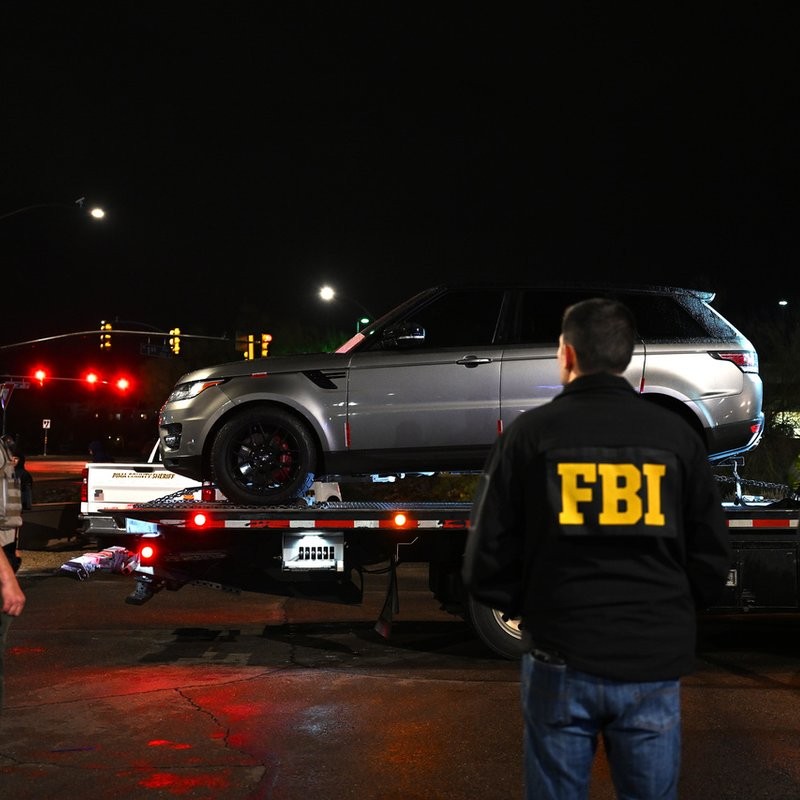
Federal agents and local deputies have spent days pulling in every pixel the neighborhood can offer. Cameras mounted above garages, angled from porches, and wired into doorbells form a patchwork surveillance net over the streets around Guthrie’s home. The two-backpack clip appears to have surfaced from that canvas, one more shard in a mosaic that might, or might not, fit the final picture.
FBI releases photos of potential subject in Nancy Guthrie’s disappearance. https://t.co/5c3icWG1Ho pic.twitter.com/P8rrtVaWAy
— News 4 San Antonio (@News4SA) February 13, 2026
Those close to the investigation describe the man in the 1:53 a.m. video as a person to identify, not a target to blame. His clothing roughly matches descriptions tied to the case. He carries a backpack like the visitor to Guthrie’s door. He is present in that crucial slice of time. Yet there is no direct evidence in public view linking him to Guthrie’s disappearance.
The distinction matters. Label him a suspect too early, and every detail of his posture, gait, and clothing becomes a mirror for collective anxiety. Treat him as an unknown lead, and he becomes what he currently is in the case file, a question mark moving through someone else’s yard in the middle of the night.
Caution From Inside the Bureau
Former FBI Supervisory Special Agent Jason Pack has walked this territory before. He describes the canvas work behind the video as slow, exhausting, and necessary. Every street, every camera, every ring of parked cars is another chance to catch a vehicle, a face, or even a shadow that narrows the field.
Pack urges restraint with this new clip. In his view, single tips like this often dissolve under scrutiny. A man in a hoodie might turn out to be a shift worker cutting through a yard, a neighbor taking a shortcut, or someone engaged in low-level trespassing that has nothing to do with a missing person case. The fact that he appears during a critical window does not, by itself, answer any of the hard questions the Guthrie investigation now faces.
At the same time, Pack emphasizes that the bureau cannot afford to shrug off such footage. The man’s clothing, the two backpacks, his direction of travel, and his distance from Guthrie’s home all demand follow-up. The priority is to identify him, rule in or rule out any connection to Guthrie, and then either fold his presence into the timeline or push it out of the story entirely.
A Vanishing in 41 Minutes
The deeper puzzle remains inside that early morning gap. The doorbell camera disconnects at 1:47 a.m. Sometime after, a person with a backpack approaches Guthrie’s front door. Before 2:28 a.m., the pacemaker stops sending readings to the phone. By midday, the house appears calm enough that relatives expect a routine virtual visit, not a welfare check.
Where was Guthrie in those minutes between the failing cameras and the silent medical device? Was anyone else inside the house? Did she leave willingly, under pressure, or not at all? The available public evidence sketches the edges of a story without revealing what happened in the rooms at the center.
Digital traces that most people never consider, such as smart doorbells and implanted medical devices, now drive the pacing of the case. A few dropped signals on a server log have become proxies for footsteps heard or not heard in the dark.
Noise, Leads, and the Cost of Certainty
The Tucson footage is not the only distraction orbiting the search for Guthrie. As the case gained attention, a man in California allegedly began sending messages to Guthrie’s family, demanding payment in bitcoin during the active missing person hunt. That separate arrest underlines a brutal reality in high-profile disappearances. When fear and uncertainty grow, opportunists move in.
Every false lead, every exploitation attempt, and every misidentified suspect drains time from the core task of finding a missing woman. At the same time, dismissing tips too quickly risks walking past the very clue that could break the case open. The man with two backpacks now sits squarely on that line.
Public speculation treats his 19-minute window as a riddle with an obvious answer. The investigative approach treats it as a path that might dead end. His movements, route options, and any vehicle he may have used are all testable facts. Until those checks are run, naming him as the figure at Guthrie’s door remains more belief than proof.
For Guthrie’s family, the timelines, canvass maps, and forensic arguments are background noise to a simpler reality. A woman left at home on a Saturday night is gone by Sunday afternoon. Cameras failed, data dropped, and somewhere in the middle, contact with her ended.
In the coming weeks, more clips may surface. Additional neighbors may realize that an old system recorded something they had ignored. A vehicle might be traced across multiple intersections. Or the man with the two backpacks may step forward and explain what he was doing in that yard just before 2 a.m.
Until that happens, the case sits in an uneasy balance. The cameras have given investigators timestamps, silhouettes, and questions. What they have not yet given is the one frame that makes all the others fall into place.
References
- Fox News: Former FBI Agent Urges Caution After Surveillance Video Circulates in Guthrie Case
- Fox News: California Man Arrested for Sending Texts to Guthrie Family Asking for Bitcoin During Missing Mother Case
- Fox News: FBI Evidence in Nancy Guthrie Case Draws Two Suspect Claims as Retired Agent Weighs In
- Fox News: Chilling 41 Minute Gap in Nancy Guthrie Case Raises Red Flags from Ex Homicide Detective
- Fox News: Latest FBI Neighborhood Canvass in Guthrie Case Could Mean Feds Have Digital Evidence, Former Agent Says