

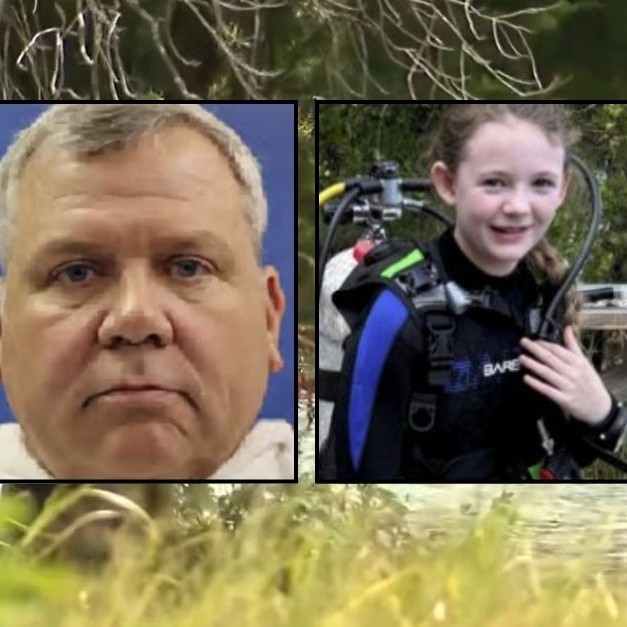
By the time anyone could say for sure when 12-year-old Dylan Harrison vanished beneath the gray water of a North Texas training lake, the clocks no longer agreed. Her class log had one story, instructors’ another, emergency dispatch tapes, something else entirely. What no one disputes is this: more than half an hour passed before she was pulled from the lake, unresponsive, while the man paid to watch her now faces a felony charge.
TLDR
A former Texas deputy who was working as a scuba instructor is charged with felony injury to a child after a 12-year-old student diver, Dylan Harrison, disappeared during a certification class and was found dead more than 30 minutes later, prompting a criminal case and a sweeping negligence lawsuit.
The class was supposed to be routine, held on August 16th, 2025, at a popular dive park southeast of Dallas. Eight students, all young, many there with parents watching from shore, entered the water under the supervision of instructor William Armstrong and divemaster Jonathan Roussel. Dylan, a middle schooler whose family had bought gear and booked the course through a Carrollton dive shop, never came home. Armstrong, a veteran lawman and assistant chief deputy in Collin County at the time, is now charged with felony injury to a child, accused of failing in the most basic duty a scuba instructor has: keep track of the kids in your care.
A Lake Built for Training, Not for Death
The Scuba Ranch, a commercial training lake near Terrell, markets itself as a controlled environment. Visibility is limited, like most Texas lakes, but platforms, lines, and submerged attractions are mapped and marked. On that August weekend, the water was busy. Certified divers practiced skills near the platforms while classes of beginners dropped below the surface for the first time.
Dylan’s path to that lake started in a strip-mall shop miles away, where the Harrisons signed her up for a junior open-water certification course. The package included classroom time, confined-water skills, and open-water checkout dives at the ranch. The promise sold to families is simple: controlled risk, experienced staff, and redundancy for when things go wrong.
On paper, the instructor assigned to Dylan looked like a safe bet. Armstrong carried a law enforcement title that implied command, wore the authority of a long career, and held a professional scuba certification. In reality, the complaint filed later in civil court paints him as dangerously exhausted before the class even began.
The Fatigue No One at the Lake Could See
The day before Dylan’s dive, Armstrong reportedly worked a full daytime shift at the sheriff’s office, then rolled straight into an overnight security job. By the time he arrived at The Scuba Ranch for the morning class, the lawsuit attacks his condition in blunt terms: little or no sleep in the past 24 hours.
Fatigue in law enforcement rarely becomes visible until something breaks. In diving, the margins are thinner. Breath, buoyancy, and awareness live on tight timelines. An instructor who misses a cue, a missing headcount, or a drifting student can lose a diver in seconds, especially in water where you cannot see more than a few feet.
Parents on shore assume those calculations are already made. They see instructors in black neoprene, tanks lined up like teeth, laminated cards listing safety rules. What they cannot see is the overtime schedule that stacked shifts through the night, or the side jobs that leave instructors, already stretched, working on autopilot.
When a Student Vanishes
Somewhere between the surface and the training platform, between descent and ascent, between roll call and the final tally, Dylan slipped away from the group. The precise moment remains contested, but every version of the day circles the same hard fact: her absence went unnoticed long enough for any rescue window to warp into a recovery mission.
Once it finally registered that she was missing, the group’s structure fractured. Roussel escorted the other students to shore. Armstrong, instead of immediately returning underwater, began searching the shoreline and dock area. Emergency services were called. Divers already on site joined the search. For a child missing underwater, every minute spent reassigning roles, debating search patterns, or scanning the surface is another minute of silence at the bottom.
Witness accounts captured in the civil filings describe a search that felt chaotic rather than coordinated. Armstrong and Roussel reportedly left the immediate search area at one point, returned, and offered little direction. For those watching, the people who had been entrusted with the children’s safety no longer appeared to be in charge of the crisis.
More than 30 minutes after Dylan was last seen, searchers finally located her in the lake. She was unresponsive. Efforts on shore were not enough. A child who entered the water with a tank on her back and a certification card within reach left the property in an ambulance that became a hearse in motion.
From Training Accident to Crime Scene
In many diving deaths, the story stops at tragedy and insurance claims. Families are told about inherent risks, signed waivers, and the unforgiving physics of pressure and breath. This case moved in a different direction.
After Dylan’s death, her parents filed a civil lawsuit that did not treat the event as an unavoidable accident. The complaint targets Armstrong, Roussel, the training agency that certified them, the dive shop that sold the course, and The Scuba Ranch itself. It describes a chain of negligence, starting with an exhausted instructor and ending with a missing child on the lakebed.
A wrongful-death lawsuit has been filed over the fatal scuba training dive of 12-year-old Dylan Harrison in Texas.
The claim alleges preventable failures, instructor negligence, and systemic safety issues within dive training. The case builds on earlier eyewitness accounts and… pic.twitter.com/Wlg9QkpOuU
— The Scuba News (@TheScubaNews) February 3, 2026
The language in the filings is surgical. It attacks staffing decisions, supervision protocols, and the decision to allow a man with essentially no sleep to take responsibility for eight student divers, including a 12-year-old. It accuses the companies involved of treating serious incidents as the cost of doing business rather than inflection points for reform.
Behind those pages, another process unfolded in silence. The internal reckoning inside Armstrong’s law enforcement agency did not play out in public, but by October, two months after the drowning, he was no longer employed there. The dive shop that booked Dylan’s class shut its doors on January 31st, closing one node in the network of entities tied to her death.
The Felony Charge
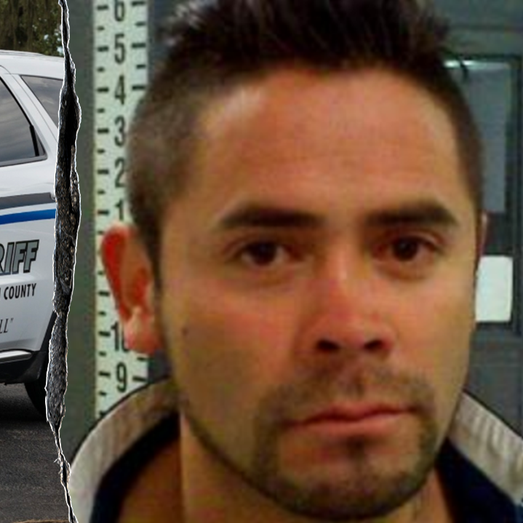
Then, months after the civil suit began to trace blame in dollars and policy changes, the case took a sharper turn. Armstrong was arrested and charged with felony injury to a child, a serious offense that reframes the August dive from tragedy to potential crime.
A former scuba instructor has been arrested and charged following the death of 12-year-old Dylan Harrison during a training dive.
This is the first criminal charge in a case The Scuba News has been tracking closely.
Full details in our latest report.🤿 👉… pic.twitter.com/cMCIBMesQi
— The Scuba News (@TheScubaNews) February 7, 2026
The charge suggests more than a simple mistake. For prosecutors to pursue a felony, they must see conduct that crosses a threshold from error into criminal negligence or worse. In this context, it centers on the allegation that an adult with specialized training, paid to protect a child in a hazardous environment, ignored or mishandled risks in a way that any reasonable professional would have recognized as unacceptable.
After his arrest, Armstrong was booked into the Kaufman County Jail, then released on a $150,000 bond. He returned to the community not as an assistant chief deputy, but as a defendant whose every decision on that lake may be replayed frame by frame in front of a jury.
No trial date has been set in public records, leaving a long, uneasy gap between the accusation and any formal verdict. Dylan’s parents live in that gap, moving between court filings, birthdays that are no longer celebrated, and the knowledge that their daughter’s final minutes exist only in bubbles and blind water.
System Cracks Exposed by a Child’s Death
Beneath the names and charges, the case cuts into a wider set of questions about how adventure sports are policed in practice. Recreational diving in the United States leans heavily on private certifying agencies, independent instructors, and liability waivers. Training sites like The Scuba Ranch occupy a gray area, selling access and structure without functioning like tightly regulated public pools.
In that ecosystem, background matters. A deputy’s badge, a laminated instructor card, and a framed certificate on the dive shop wall can create the illusion of layered oversight. Dylan’s death challenges that image. If everyone in the chain did what the system actually expects of them, how does a child disappear in a small, charted lake for more than 30 minutes before anyone brings her back to the surface?
Fatigue screening for instructors is rarely more than an honor system. Double shifts, side security jobs, and on-call law enforcement roles are treated as personal hustle, not safety red flags. When something goes wrong, that private grind suddenly becomes public evidence.
The case also tests the boundaries of criminal liability in sports instruction. If Armstrong’s conduct is ultimately found criminal, it will send a message through dive shops, climbing gyms, rafting outfitters, and every operation that puts minors into high-risk environments on the promise of safe thrill. If he is acquitted, families sign up for the next season’s classes with the same waivers, the same assurances, and the same blind trust.
What Remains Unanswered
Even with a felony case underway and a dense civil complaint on file, core questions linger. Exactly how long was Dylan separated from the group before anyone noticed? Why did the initial search deviate onto land when a student was last seen underwater? Who in the chain of businesses and agencies first knew about Armstrong’s overnight shift, and why did no one pull him off the class?
The water at The Scuba Ranch has long since closed over the spot where Dylan lay unseen. New divers will drop to the platforms, practice buoyancy, and take selfies by the submerged attractions. The surface reveals nothing about what happened there on August 16th, 2025.
In court, though, the lake is not quiet. It is a crime scene built from logs, timelines, and gaps in memory. Until a jury, a judge, or a settlement lays out a final version of events, the case of the exhausted deputy, the missing student diver, and the frantic 30 minutes at a Texas training lake will hang as a warning over every parent who signs a waiver and hands a child over to the water.